Is your dogs behaviour truly behavioural or could it be pain?
Did you know that between 30 and 80% of behavioural cases could have an underlying physical health complaint, such as pain? (Mills et al. 2020). Sometimes, what we interpret as a behavioural problem may actually be a dog's way of communicating that they do not feel well physically.
Behavioural challenges are not always associated with pain, however, pain should always be ruled out as a factor! Since our pet’s are unable to tell us how they feel, it is vital that animal professionals are able to read their behaviour, afterall "pain is whatever the patient says it is, and exists whenever the patient says it does" (Margo McCaffery).
With Becka’s background as a registered veterinary nurse, clinical animal behaviourist and pet owner, pain is a topic that has become a special interest for her and one that she is extremely passionate about; she firmly believes that no animal should suffer in silence and that animal professionals and owners should be collaborating to improve the health and welfare of animals by identifying abnormalities early. Not only does Becka has several degree level modules in pain and analgesia (pain relief) but Becka is proud to now be the first Dynamic Dog Practitioner in the Channel Islands!
What behaviours could be associated with pain:
Reluctance having harnesses/collars or coats placed or removed
Eating non-food items
Housesoiling with negative results on laboratory tests
Pulling excessively on the lead which training does not improve
Separation related behaviours
Siting with an unusual or 'sloppy' posture
Showing reluctance to sit or lie down, perhaps even during puppy classes
Displaying sensitivity to movements, sounds, grooming or handling
Unusual movements, for example when running, climbing stairs or transitioning between postures
Appearing ‘lazy', ‘reluctant’ or 'stubborn'
Displaying reactivity towards other dogs or people
Or maybe you feel that something is not quite right but you are unable pinpoint what it is and would like to know more?
Why is it important to identify pain?
It is unethical to expect a dog in pain to complete certain skills, possible health concerns should be ruled out before we begin working on training which could exacerbate pain
Pain can alter a dogs cognitive bias, which means they can develop a more pessimistic outlook
Pain can reduce a dogs threshold to cope with stressors which could increase the chance of biting and becomes a safety risk
Pain is an unpleasant experience and can impact quality of life or welfare
Undiagnosed pain can result in behavioural challenges which can result in rehoming or euthanasia
Pain is often associated with conformational, postural or movement abnormalities which could worsen without intervention
Pain is not only a physical experience, it can chronically impact a dogs emotional and cognitive health too
Pain is associated with the same brain regions as fear and anxiety - the two come hand in hand
Pain becomes harder to manage and treat when the nervous system becomes sensitised/wound up
Why does pain often get missed?
Identifying pain in dogs is not always straightforward, particularly when behavioural challenges are also present. There are several reasons why pain could be overlooked or missed:
Physical examinations can be difficult since dogs with behavioural challenges may find veterinary examinations unpleasant, frightening or painful
Nervous or fearful dogs may hold tension in their muscles, making it harder to assess their natural posture, movement and range of motion, thus, masking abnormalities
Activation of the sympathetic nervous system and the release of stress hormones, such as cortisol and adrenaline may temporarily mask signs of pain or pain perception
Pain trials are not always conclusive if a medication has not been prescribed for long enough, has been administered inapppropriately or has not targetted a specific pain type
Recognising subtle changes in gait, posture and daily activities requires specific knowledge and observation skills, it is impossible for pet professionals to know everything
Humans are generally more familiar with obvious signs seen with acute pain, however, signs of chronic pain can be far more subtle (change in behaviour may be the only sign)
We have become accustomed to seeing common abnormalities in dogs and often assume they are normal
Veterinary professionals work hard and are offen pressured for time, consults may be time-limited, making it difficult to observe or discuss every subtle physical observation
Pain is an individual experience and dogs may vary in their signs of pain; some may become restless, excitable or hyperactive whereas others may be quiet, sleepy or withdrawn
What is a Dynamic Dog Assessment?
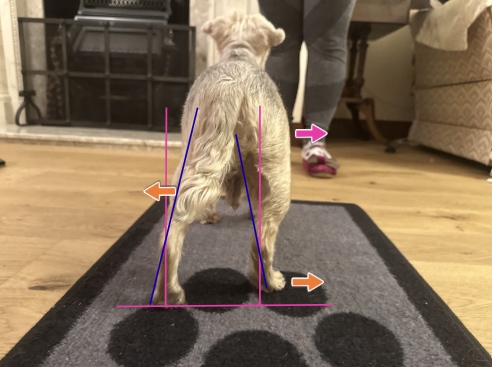
A Dynamic Dog assessment is undertaken by a Dynamic Dog Practitioner who has undergone intensive training, it involves a process to assess your dogs conformation, posture, behaviour, movement and activities of daily living; the assessment spans over two weeks to look for any possible consistent abnormalities and the dog is assessed holistically, rather than focussing on just one piece of the puzzle.
The Dynamic Dog process includes:
Discussion - a 90-minute consultation to discuss your pet’s behavioural and life history
Data gathering - collection of images and videos taken by yourself or with Becka’s support if required
Data analysis - Becka marks up images and observes video footage to look for any possible abnormalities
Report - a report is compiled, consistent findings are highlighted with evidence; it is recommended to discuss any abnormalities with your veterinarian
Follow up support - all findings will be discussed with you and follow up support can be provided as required on a case-by-case basis (veterinary referral may be required)
Dynamic Dog Assessments are not a diagnosis or alternative to a veterinary examination:
Please note that Dynamic Dog assessments are NOT an alternative to vital veterinary assessments or a diagnosis, they are purely designed to create a bridge between behaviour and veterinary medicine, aiming to provide your veterinarian with the objective observations that could be missed in the consulting room; particularly with complex behavioural cases. It is your veterinarians professional opinion and clinical judgment as to whether it would be beneficial to undertake a pain trial, further imaging/diagnostics or to seek specialist advice.
Dynamic Dog Assessments can be completed for reactive/aggressive dogs:
The beauty of the Dynamic Dog Assessment is that it can be undertaken with dogs of all temperaments, since the assessment is based on observations, we do not need to physically touch your dog to complete the assessment; the assessments can even be completed online!
Investment:
Dynamic Dog Assessment (with report) = £150
Repeat Dynamic Dog Assessment (with report = £75
Visit fee to assist with obtaining data if required = £50 per visit (a minimum of 2 visits are expected per assessment).
Although I am a certified Dynamic Dog Practitioner and offer Dynamic Dog Assessments, I would like to acknowledge and give credit to Gemma Harvey, who developed the Dynamic Dog approach and created the opportunity for practitioners like myself to offer this valuable service. I am grateful for her work, knowledge and dedication in bringing greater awareness to the relationship between physical health, movement and behaviour in dogs.
Because sometimes, what looks like a behavioural problem may actually be a dog trying to tell us that something hurts. Contact us to discuss our Dynamic Dog Assessments further.