Sniffing, Is it really that important?
As dog owners, we all know that our dogs spend a large portion of their day sniffing, but have you ever wondered why? In this article, clinical animal behaviourist Becka from Companion Conundrums Limited outlines the anatomy of the dog's nose and explains the function and importance of sniffing for our dogs.
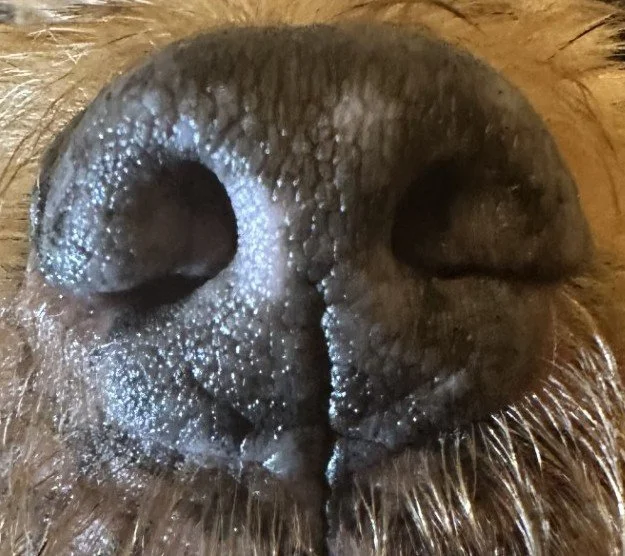
When a dog breathes in, scent particles in the air move towards their nose. Tiny bony scroll-like structures called turbinates control filtration and air flow into the respiratory tract whilst warming the air; the turbinates are covered by epithelial tissue which contains scent receptors and mucous to trap scent particles. The receptors send signals to the brain which converts the signals to scent and assists the dog in detecting odours.
Dogs do not only rely on scent, they also have an organ in the hard palate of their mouth called the vomeronasal gland or Jacobson's organ which allows them to detect invisible chemical substances called pheromones; it is thought that this sense is somewhere between taste and smell. Additionally, dogs have a vertical idented groove called the philtrum, located between their nostrils that runs down to their upper lip; when a dog licks their nose, they collect particles which have become trapped in saliva at the site of the philtrum and deliver them to the vomeronasal gland. Dogs that are nervous may lick their noses more frequently to gain more information about their surroundings.
Pheromones provide dogs with information and aid communication, they assist with social bonding, identification, signaling, regulation of emotional state and reproduction. Pheromones are produced by various glands located in the skin, face, ears, mammary glands, feet, genitals, and anus; although sometimes embarrassing, this explains why dogs often show interest in these sites when meeting someone new. Pheromones are species specific, for this reason, dogs may become confused or frustrated when they are unable to obtain this chemical information from people, which may lead them to display undesired behaviours.
Nervous dogs may freely allow other dogs to collect this information by rolling onto their back and exposing the mammary glands or by urinating. Conversely, dogs that are fearful may attempt to protect this information by displaying reactive behaviour to achieve space or covering their anal glands by tucking their tail closely over the anus.
When a dog eliminates, pheromones are deposited in the urine or faeces, which provide useful information such as health and sexual status as well as emotional state. Pheromones are long lasting, so a dog does not need to be physically present for the exchange of this information to occur. When a dog is collecting the scent of pheromones, they typically go still, raise their head, the lower jaw drops and the upper lip curls, they inhale deeply and the teeth may be exposed, they may also chatter their teeth or salivate; this behaviour is called the flehmen response and often causes the dog to look disgusted or perplexed.
Research has suggested that when dogs sniff, the brain releases endorphins such as dopamine which are associated with reward, pleasure, and improved mood. Sniffing can also assist with emotional regulation by triggering the parasympathetic nervous system to reduce heart rate and blood pressure, in turn, reducing stress and supporting a calmer state of mind. Sniffing also helps a dog learn about their environment, which is vital for a puppy's development and is a great source of mental stimulation, particularly for our older dogs who may have reduced physical activity or may suffer from anxiety-related behaviours due to poor health.
So, next time you are out walking with your dog, remember to pause and allow them to take that opportunity to sniff.